Skip to main content
Contents Dark Mode Prev Up Next \(\newcommand{\R}{\mathbb R}
\newcommand{\reference}[1]{\overline{#1}}
\newcommand{\lt}{<}
\newcommand{\gt}{>}
\newcommand{\amp}{&}
\definecolor{fillinmathshade}{gray}{0.9}
\newcommand{\fillinmath}[1]{\mathchoice{\colorbox{fillinmathshade}{$\displaystyle \phantom{\,#1\,}$}}{\colorbox{fillinmathshade}{$\textstyle \phantom{\,#1\,}$}}{\colorbox{fillinmathshade}{$\scriptstyle \phantom{\,#1\,}$}}{\colorbox{fillinmathshade}{$\scriptscriptstyle\phantom{\,#1\,}$}}}
\)
Solutions 1.6 Answers to Pretests
1.2 Algebra Pretest
1.2.1. Working with Real Numbers.
Answer .
\(\displaystyle \frac{3}{2}-\frac{2}{3} = \frac{5}{6}\)
\(\displaystyle \frac{3}{2}\cdot\frac{2}{3} = 1\)
\(\displaystyle |3−6|+6|−3|=21\)
\(\displaystyle \frac{3−6}{-3\times 6} = \frac{1}{6}\)
1.2.2. Working with Exponents.
Answer .
\(\displaystyle \left(-\sqrt{2}\right)^2-\left(\sqrt{2}\right)^4+\left(\sqrt{2}\right)^0+\sqrt{\left(-2\right)^4} = 3\)
\(\displaystyle \sqrt{(-3)^2+(-4)^2} = 5\)
\(\displaystyle \left(\sqrt[3]{-8}\right)^{-1} = -\frac{1}{2}\)
\(\displaystyle \left(\frac{4}{9}\right)^{3/2} = \frac{8}{27}\)
\(\displaystyle 27^{-2/3}=\frac{1}{9}\)
\(\displaystyle \frac{2^{12}}{2^{10}} = 4\)
1.2.3. Using Laws of Exponents.
Answer .
\(\displaystyle \frac{x^5}{x^3} = x^2\)
\(\displaystyle x^5\cdot x^3 = x^8\)
\(\displaystyle \left(x^5 x^1\right)^3 = x^{18}\)
1.2.4. Converting to Exponential Form.
Answer .
\begin{equation*}
\frac{3}{4x^5} - \sqrt{x^5} + \frac{1}{\sqrt[5]{x^2}} + \frac{2}{5 x^{-2}}
= \frac{3}{4} x^5 - x^{5/2} + x^{-2/5} + \frac{2}{5} x^2
\end{equation*}
1.2.5. Using Scientific Notation.
Answer .
\(\displaystyle \left(1.5\times 10^3 \right)\times\left(4.0 \times 10^{-2}\right) = 6.0\times 10^{1} = 60\)
\(\displaystyle \frac{6.5\times 10^3}{2.0 \times 10^{-2}} = 3.25 \times 10^{5} = 325000\)
\(\displaystyle \frac{6.5 \times 10^{-2}}{2.0\times 10^3} = 3.25 \times 10^{-5} = 0.0000325\)
\(\displaystyle \left(1.5\times 10^3 \right)+\left(4.0 \times 10^{-2}\right) = 1500.04 = 1.50004 \times 10^{3}\)
1.2.6. Reducing Radicals.
Answer .
\(\displaystyle \sqrt{16 x^3 y^6 z^2} = 4|x y^3 z | \, \sqrt{x}\)
\(\displaystyle \sqrt[3]{16 x^5 y^6 z^3} = 2 x y^2 z \, \sqrt[3]{2 x^2}\)
\(\displaystyle \sqrt[4]{16 x^5 y^6 z^4} = 2 |x y z| \, \sqrt[4]{x y^2}\)
1.2.7. Operations with Polynomial Expressions.
Answer .
\(\displaystyle -x^6+x^5+3 x^4-x^3-x^2-2 x\)
\(\displaystyle 6 x^2-7 x-3\)
\(\displaystyle 4 x y^2-2 y^3 -4 x^2+2 x y+y^2+3 x-2 y+1\)
1.2.8. Operations with Rational Expressions.
Answer .
\(\displaystyle \displaystyle
\frac{7-x^2}{x^2-2 x-3}
\frac{x(7-x)}{(x-3) (x+1)}\)
\(\displaystyle \displaystyle \frac{x+1}{2x-6}\)
\(\displaystyle \displaystyle \frac{x (x+3)}{x+1} = \frac{x^2+3x}{x+1}\)
1.2.9. Factoring Trinomials.
Answer .
\(\displaystyle x^2+2 x-15 = (x-3) (x+5) \)
\(\displaystyle x^2-25x = x(x-25)\)
\(\displaystyle x^2-25 = (x-5)(x+5)\)
\(\displaystyle x^2-10 x+25 = (x-5)^2\)
\(\displaystyle 2 x^2-5 x-3 = (2x+1)(x-3)\)
\(\displaystyle 2 x^2+5 x-3 = (2x-1)(x+3)\)
\(\displaystyle x^2+2 x-15 = (x-3)(x+5)\)
\(\displaystyle 9x^4-y^2 = (3x^2-y)(3x^2+y)\)
\(\displaystyle a^2-b^2 = (a-b)(a+b)\)
\(\displaystyle a^2+2ab+b^2 = (a+b)^2\)
\(\displaystyle a^2-2ab+b^2 = (a-b)^2\)
1.2.10. Finding the Domain.
Answer .
\(\displaystyle (-\infty,2]\)
\(\displaystyle (-\infty,2)\cup(2,\infty)\)
\(\displaystyle (-\infty,2)\)
\(\displaystyle [0,\infty)\)
\(\displaystyle (-\infty,\infty)\)
1.2.11. Solving Equations.
Answer .
\(\displaystyle x =0,-\frac{1}{4}\)
\(\displaystyle x = \pm 3\)
\(\displaystyle x=-2,0,2\)
\(\displaystyle x=1,\frac{5}{3}\)
\(\displaystyle x=\frac{7}{6}\)
\(\displaystyle x=\pm \sqrt{7}\)
1.3 Functions Pretest
1.3.1. Cartesian Plane.
Answer .
It’s a circle centered at
\((3,1)\) with radius
\(r = 4\text{.}\) This is described by the equation
\((x-3)^2+(y-1)^2 = 4^2\text{.}\) This meets the
\(x\) -axis at two points:
\((3-\sqrt{15},0)\) and
\((3+\sqrt{15},0)\text{.}\)
1.3.2. Linear Equations.
Answer .
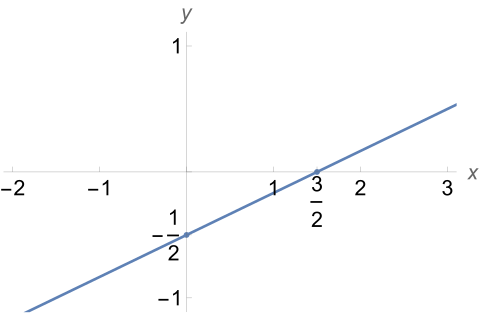
\(\displaystyle 2x-6y = 3\)
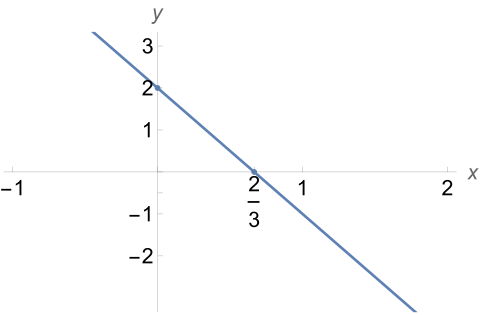
\(\displaystyle y = -3x+2\)
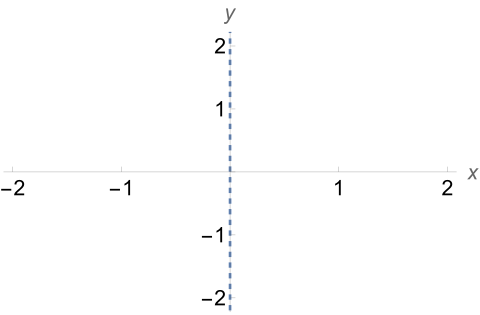
\(x = 0\) is the
\(y\) -axis
1.3.3. Point-Slope Form.
Answer .
Point-Slope Form: \(y-y_0 = m(x-x_0)\text{.}\) In this case, \(m=-\frac{7}{8}\) and the line is given by
\begin{equation*}
y-3 = -\frac{7}{8}\left(x+2\right) \quad \Rightarrow \quad y = -\frac{7}{8} x + \frac{10}{8}
\end{equation*}
1.3.4. Linear Models.
Answer .
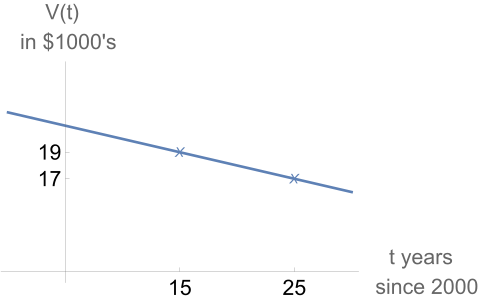
Rate of change:
\(m = \frac{-2}{10}\) thousands of dollars per year.
\begin{equation*}
V(t) = -\frac{2}{10}(t-15)+19
\end{equation*}
Purchase price:
\(V(0) = 22\) thousands of dollars.
1.3.5. Evaluating Functions.
Answer .
\(\displaystyle f(-2)=-16\)
\(\displaystyle f(-t)= -3 t^2-t-2\)
\(\displaystyle f(t+2)=-3 t^2-11 t-12\)
\(\displaystyle f(t)+2 = t-3 t^2\)
1.3.6. Piecewise-Defined Functions.
Answer .
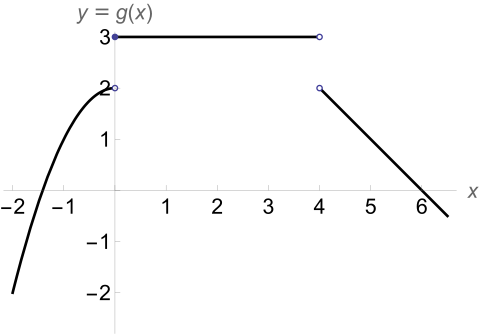
\(\displaystyle g(-2) = -2\)
\(\displaystyle g(0) = 3\)
\(\displaystyle g(2) = 3\)
\(\displaystyle g(6) = 0\)
1.3.7. Graphs of Parent Functions.
Answer .
You may quickly compare your results with those in
Section 7.3 or use a graphing tool.
1.3.8. Transforming Parent Functions.
Answer .
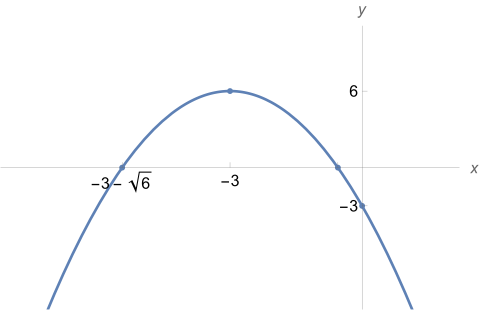
1) Shift the graph left
\(3\) units; 2) reflect over the
\(x\) -axis; 3) shift the graph up
\(6\) units.
Zeros at
\(x=-3\pm\sqrt{6}\text{.}\)
1.3.9. Composition of Functions.
Answer .
\(\displaystyle (f\circ g)(2) = 0\)
\(\displaystyle (g\circ f)(8) = 4\)
\(\displaystyle (g\circ f)(0) = -4\)
\((f\circ f)(8)\) is undefined!
\(\displaystyle (g\circ g)(x) = x^4\)
\(\displaystyle (g\circ f)(x) = x-4\)
1.3.10. Inverse Functions.
Answer .
\(\displaystyle f^{-1}(1) = 3\)
\(\displaystyle (f^{-1})(-1) = 0\)
\(\displaystyle (f\circ f^{-1})(3) = 3\)
\(\displaystyle (f^{-1}\circ f)(1) = 1\)
1.3.11. Finding an Inverse Function.
Answer .
\(f(x) = 4-3x\text{,}\) \(f^{-1}(x) = \frac{4-x}{3}\)
\(g(x) = \sqrt[3]{4-3x}\text{,}\) \(g^{-1}(x) = \frac{1}{3} \left(4-x^3\right)\)
\(h(x) = \frac{4}{3x}\text{,}\) \(h^{-1}(x) = \frac{4}{3x}\)
\(k(x) = \frac{4-3x}{1+x}\text{,}\) \(k^{-1}(x) = \frac{4-x}{x+3}\)
1.4 Exponential and Logarithms Pretest
1.4.1. Exponential and Logarithmic Functions.
1.4.2. Transforming Graphs of Exponential Functions.
Answer .
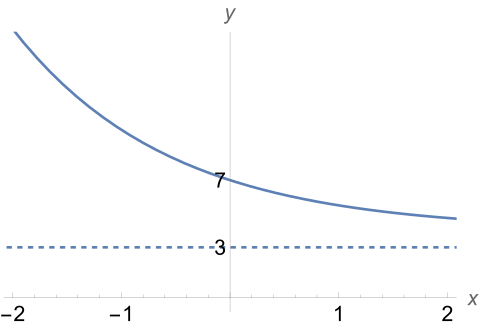
The graph is 1) reflected over the
\(y\) -axis; 2) scaled vertically by a factor of
\(3\text{,}\) then shifted up
\(4\) units.
The
\(y\) -intercept is at
\((0,7)\text{.}\) There is a horizontal asymptote at
\(y=3\text{.}\) The domain is still
\((-\infty,\infty)\text{,}\) but the range is now
\((3,\infty)\text{.}\)
1.4.3. Working with Logarithmic Expressions.
Answer .
\(\log_2 (4) = 2\text{,}\) because
\(2^2 = 4\text{.}\)
\(\log_4 (2) = 1/2\text{,}\) because
\(4^{1/2} = 2\text{.}\)
\(\log_2 (0)\) is undefined because
\(2^x \neq 0\) is never zero.
\(\log_{1/2} (8) = -3\) because
\((1/2)^{-3} = 8\text{.}\)
\(\ln \left(\frac{1}{\sqrt[3]{e}}\right) = - \frac{1}{3}\) because
\(e^{-1/3} = \frac{1}{\sqrt[3]{e}}\text{.}\)
\(\ln(1) = 0\) because
\(e^0 = 1\text{.}\)
1.4.4. Using Properties of Logarithms 1.
Answer .
\begin{equation*}
\log_b\left(\frac{X Y^2}{b^3 \, \sqrt{Z}}\right) = -6
\end{equation*}
1.4.6. Using Properties of Logarithms 3.
Answer .
\begin{equation*}
3^{2\log_3(5)} = 25
\end{equation*}
1.4.7. Solving Exponential and Logarithmic Equations.
Answer .
\(\displaystyle e^{-3x}=7 \quad \Rightarrow \quad x = - \frac{1}{3}\ln(7)\)
\(\displaystyle \frac{1}{2-e^x}=2 \quad \Rightarrow \quad x = \ln(3/2)\)
1.4.8. Exponential Models.
Answer .
Initially,
\(T(0) = 140+60 = 200\) degrees.
Solve
\(T(t) = 100\) to find
\(t \approx 6.26\) minutes.
Room temperature is about 60 degrees. Why?
1.5 Trigonometry Pretest
1.5.1. Radian Measure.
Answer .
Draw a circle of any radius. Measure an arc along the circle twice the radius in length. The corresponding angle is two radians. Since the circumference of a circle is
\(2\pi r\text{,}\) an angle of
\(\pi\) radians corresponds to an arc half the circumference. So
\(\pi\) radians is
\(180^\circ\text{.}\)
1.5.2. Arc-Length.
Answer .
\begin{equation*}
s = (\text{$4$ inches}) \times 120^\circ \times \frac{\pi}{180^\circ} = \text{$8.38$ inches}
\end{equation*}
1.5.3. Right Triangle Trigonometry.
Answer .
The hypotenuse is
\(8\) inches. The side adjacent to
\(\theta\) is
\(\sqrt{60} = 2\sqrt{15}\text{.}\)
1.5.4. Trigonometric Functions.
Answer .
Using
\(x=-3\text{,}\) \(y=1\text{,}\) and
\(r=\sqrt{10}\) we have
\(\sin(\theta) = 1/\sqrt{10}\text{,}\) \(\cos(\theta) = -3/\sqrt{10} \text{,}\) \(\tan(\theta) = -1/3\text{,}\) \(\csc(\theta) = \sqrt{10}\text{,}\) \(\sec(\theta) = -\sqrt{10}/3\text{,}\) and
\(\cot(\theta) = -3\text{.}\)
1.5.5. Trigonometric Functions.
Answer .
Using
\(x=1\text{,}\) \(y=-4\text{,}\) and
\(r=\sqrt{17}\) we have
\(\sin(\theta) = -4/\sqrt{17}\text{,}\) \(\cos(\theta) = 1/\sqrt{17} \text{,}\) \(\tan(\theta) = -4\text{,}\) \(\csc(\theta) = -\sqrt{17}/4\text{,}\) \(\sec(\theta) = -sqrt{17}\text{,}\) and
\(\cot(\theta) = -1/4\text{.}\)
1.5.6. Evaluating Trigonometric Functions Using Reference Angles.
1.5.7. Graphs of Trigonometric Functions.
1.5.8. Trigonometric Equations.
Answer .
\(\theta = \pi/2 + 2\pi k\) where
\(k\) is any integer. That is,
\(\theta\) is any angle coterminal to
\(\pi/2\text{.}\)
1.5.9. Inverse Trigonometric Functions.
Answer .
\(\displaystyle \sin^{-1}(\sqrt{2}/2) = \pi/4\)
\(\displaystyle \arccos(-\sqrt{2}/2) = 3\pi/4\)
\(\displaystyle \arctan(-1) = -\pi/4\)
1.5.10. Using Trigonometric Identities.
Answer .
\(\frac{\sin ^3(x) \left(1-\cos ^2(x)\right)}{\tan (x) \csc ^2(x)} = \sin ^6(x) \cos (x)\)
1.5.11. Addition Formulas.
Answer .
Use the Pythagorean Identity to find the missing trigonometric function values.
\begin{equation*}
\sin(\alpha + \beta) = 0.2 \times 0.3 + \sqrt{0.96} \times \sqrt{0.91}
\end{equation*}
\begin{equation*}
\cos(\alpha+\beta) = \sqrt{0.96} \times 0.3 - 0.2 \times \sqrt{0.91}
\end{equation*}