Skip to main content
Contents Dark Mode Prev Up Next \(\newcommand{\R}{\mathbb R}
\newcommand{\reference}[1]{\overline{#1}}
\newcommand{\lt}{<}
\newcommand{\gt}{>}
\newcommand{\amp}{&}
\definecolor{fillinmathshade}{gray}{0.9}
\newcommand{\fillinmath}[1]{\mathchoice{\colorbox{fillinmathshade}{$\displaystyle \phantom{\,#1\,}$}}{\colorbox{fillinmathshade}{$\textstyle \phantom{\,#1\,}$}}{\colorbox{fillinmathshade}{$\scriptstyle \phantom{\,#1\,}$}}{\colorbox{fillinmathshade}{$\scriptscriptstyle\phantom{\,#1\,}$}}}
\)
Section 11.2 More Inverse Trig Functions
As we did in
Section 11.1 , each of the remaining five trigonometric functions may be restricted to a preferred domain on which it is one-to-one and then define an inverse function. In this section, we briefly discuss the inverse sine function, arcsine, and the inverse cosine function, arccosine. See a Precalculus or Calculus textbook for the inverse functions of secant and cosecant.
Definition 11.2.1 . Inverse Sine (Arcsine).
For any real number
\(-1\leq y \leq 1\text{,}\) we define
\(\sin^{-1}(y) = \theta\) to be the unique angle
\(\theta\) satisfying the two properties:
\(\displaystyle -\pi/2 \leq \theta \leq \pi/2\)
\(\displaystyle \sin(\theta) = y\)
We also use the notation
\(\arcsin(y) = \sin^{-1}(y)\) and call this the
arcsine function.
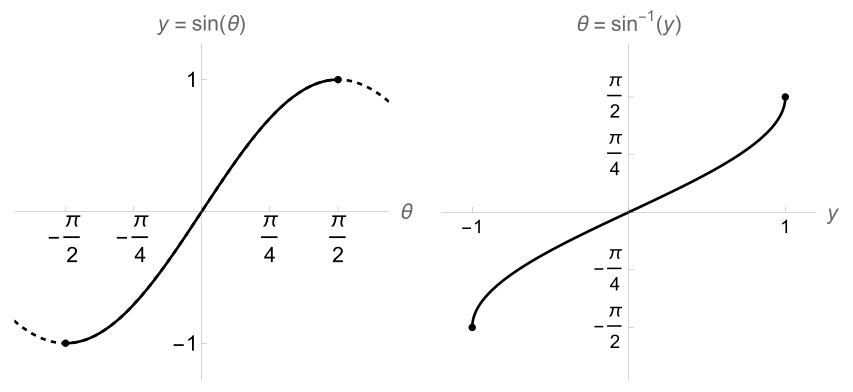
The graph of arcsine is obtained by reflecting the graph of
\(y = \sin(\theta)\) on the interval
\([-\pi/2,\pi/2]\) across the line
\(y=\theta\text{.}\)
Looking at the left graph, we observe The domain of arcsine is
\([-1,1]\) and the range is
\([-\pi/2,\pi/2]\text{.}\)
Definition 11.2.2 . Inverse Cosine (Arcosine).
For any real number
\(-1\leq x \leq 1\text{,}\) we define
\(\cos^{-1}(x) = \theta\) to be the unique angle
\(\theta\) satisfying the two properties:
\(\displaystyle 0 \leq \theta \leq \pi\)
\(\displaystyle \cos(\theta) = x\)
We also use the notation
\(\arccos(x) = \cos^{-1}(x)\) and call this the
arccosine function.
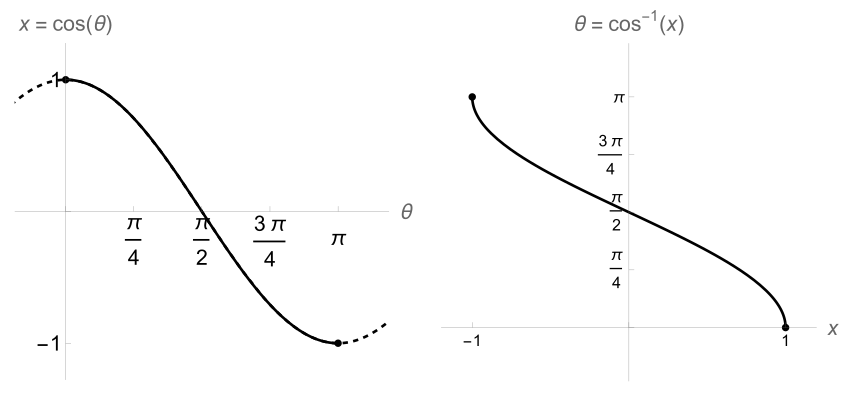
The graph of arccosine is obtained by reflecting the graph of
\(x = \cose(\theta)\) on the interval
\([0,\pi]\) across the line
\(x=\theta\text{.}\)
Looking at the left graph, we observe The domain of arccosine is
\([-1,1]\) and the range is
\([0,\pi]\text{.}\)
Example 11.2.3 . Evaluating Inverse Trigonometric Functions.
Evaluate each expression below reporting results in radians.
\(\displaystyle \sin^{-1}(1)\)
\(\displaystyle \cos^{-1}(0)\)
\(\displaystyle \arccos{-1}(-1)\)
\(\displaystyle \arcsin(1/2)\)
\(\displaystyle \cos^{-1}(-1/2)\)
Solution .
\(\displaystyle \sin^{-1}(1) = 0\)
\(\displaystyle \cos^{-1}(0) = \pi/2\)
\(\displaystyle \arccos{-1}(-1) = \pi\)
\(\displaystyle \arcsin(1/2) = \pi/6\)
\(\displaystyle \cos^{-1}(-1/2) = 2\pi/3\)