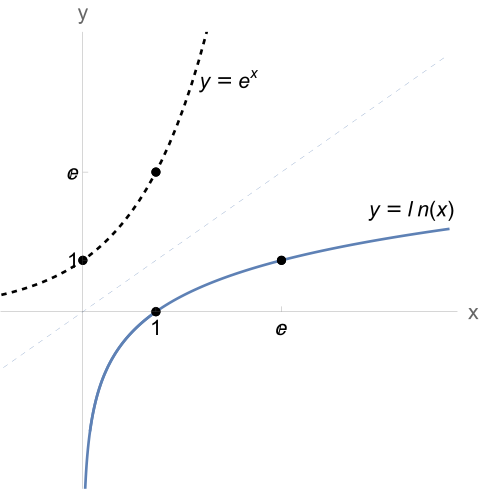
The base \(e\) exponential function \(f(x) = e^x\) is one-to-one has an inverse function \(f^{-1}\) called the natural logarithm function denoted by \(f^{-1}(y) = \ln(y) = \log_e (y)\text{.}\)
Alternatively, exponential equations are equivalent logarithmic equations according to
\begin{equation*}
y = e^x \quad \text{if and only if} \quad \ln(y) =x.
\end{equation*}
Observe that the natural logarithm returns the exponent in the base \(e\) exponential equation. Below is the graph of the natural logarithm (solid curve).
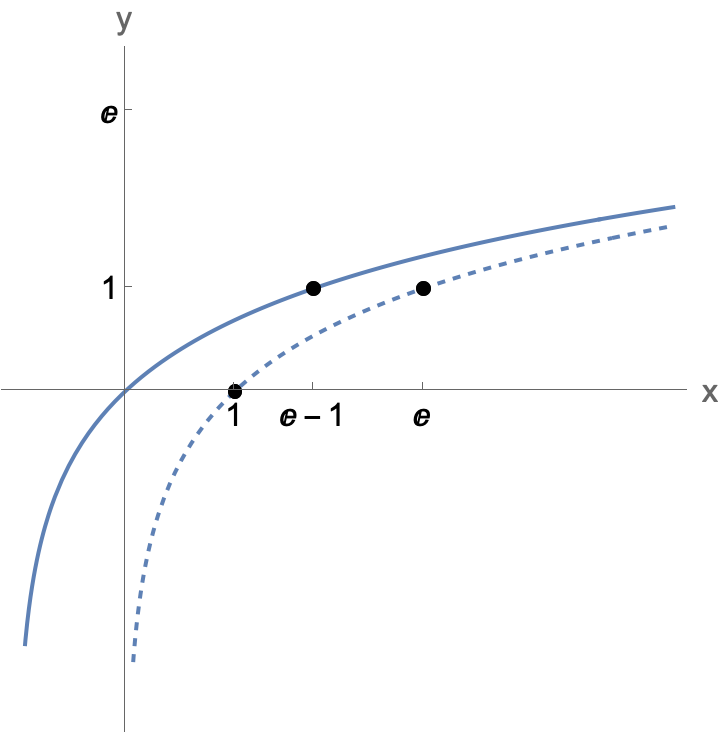
We require that the input into the logarithm is positive. In this case, \(x+1 \gt 0\) or equivalently, \(x \gt -1\text{.}\) The domain is then the interval \((-1,+\infty)\text{.}\) Adding one to the input has the effect of translating the graph one unit to the left so that the vertical asymptote of the logarithm is now \(x=-1\text{.}\)
Figure8.4.6.The graph of \(y = \ln(x+1)\) (solid) compared to \(y = \ln(x)\) (dashed).