Section 11.1 Arctangent
Trigonometric functions periodically repeat their values and as such are not one-to-one functions and do not have inverse functions. To overcome this issue, we
restrict the domain of each trigonometric function to an interval (or intervals) where they are one-to-one and define an inverse function corresponding to this restricted domain. In this section, we will examine how this is done for the three trigonometric functions tangent, sine, and cosine. I recommend you first review the interpretation of these functions on the unit circle (see
Theorem 10.5.2).
Recall that the tangent of an angle
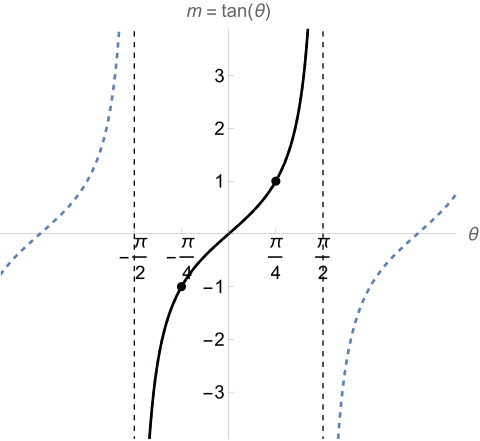
\(\theta\) returns the slope of the line formed by the angle’s terminal ray when in standard position. Below is the graph of
\(m = \tan(\theta)\text{.}\) It is periodic with period
\(\pi\) and is not a one-to-one function. It has range
\((-\infty,\infty)\text{.}\)
If we restrict its domain to the interval
\(-\pi/2 \lt \theta \lt \pi/2\) we obtain a graph which is one-to-one with the same range. This is indicated by the solid curve above. This “restricted” tangent function has an inverse function which we denote by
\(\tan^{-1}\text{.}\)
Definition 11.1.1. Inverse Tangent.
For any real number
\(m\text{,}\) we define
\(\tan^{-1}(m) = \theta\) to be the unique angle
\(\theta\) satisfying the two properties:
-
\(\displaystyle -\pi/2 \lt \theta \lt \pi/2\)
-
\(\displaystyle \tan(\theta) = m\)
Example 11.1.2. Evaluating Inverse Tangent.
-
Consider \(\theta = \pi/4\text{.}\)
-
Observe that
\(\pi/4\) is in our restricted domain
\((-\pi/2,\pi/2)\text{;}\) and
-
\(\tan(\pi/4) = 1\text{.}\)
As a result, \(\tan^{-1}(1) = \pi/4\text{.}\)
-
Consider
\(\theta = -\pi/4\text{.}\) Observe that
\(-\pi/4\) is in our restricted domain
\((-\pi/2,\pi/2)\) and
\(\tan(-\pi/4) = -1\text{.}\) As a result,
\(\tan^{-1}(-1) = -\pi/4\text{.}\)
-
Consider
\(\theta = 3\pi/4\text{.}\) Then
\(\tan(3\pi/4) = -1\text{.}\) But,
\(\theta\) is not in the domain
\((-\pi/2,\pi/2)\) and
\(\tan^{-1}(-1) \neq 3\pi/4\text{.}\) In fact, we saw
\(\tan^{-1}(-1) = -\pi/4\) above.
There is an alternative notation for inverse trigonometric functions that avoids any possible confusion. In this case, the inverse tangent function is also known as the
arctangent function and is denoted by “
\(\arctan\)”
\begin{equation*}
\arctan(m) = \tan^{-1}(m) = \theta \quad \Leftrightarrow \quad \tan(\theta) = m, \, -\pi/2 \lt \theta \lt \pi/2.
\end{equation*}
Example 11.1.4. Evaluating Inverse Tangent.
To find
\(\arctan(-\sqrt{3})\) we first note that
\(\tan(\pi/3) = \sqrt{3}\) from the special triangle in
Section 9.3. Adjusting for the quadrant,
\(\tan(-\pi/3) = -\sqrt{3}\) and
\(-\pi/3\) is in our restricted domain. Thus,
\begin{equation*}
\arctan(-\sqrt{3}) = \tan^{-1}(-\sqrt{3}) = - \pi/3.
\end{equation*}
A calculator can estimate values of arctangent, but make sure you know what mode (degree or radian) your calculator is in and you interpret the result correctly.
Example 11.1.5. Using Technology.
Use a calculator to find all the solutions to the equation
\(\tan(\theta) = -3\text{,}\) for
\(\theta\) in the interval
\([0,2\pi)\text{.}\)
Solution.
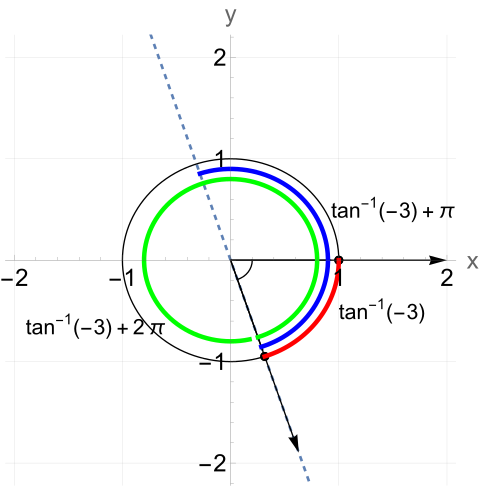
We are looking for angles \(\theta\) within the first positive revolution around the unit circle whose tangent is \(-3\text{.}\) Now one angle whose tangent is \(-3\) is
\begin{equation*}
\arctan(-3) \approx -1.25
\end{equation*}
which I obtained from a calculator in radian mode and using the “2ND” “TAN” buttons on my scientific calculator. (Consult the instructions for your specific device.) But, remember that this result is in the interval
\((-\pi/2,\pi/2)\text{,}\) by
Definition 11.1.1. Adding
\(\pi\) radians gives one solution
\(\theta = -1.25 + \pi \approx 1.89\) radians in Quadrant II. Adding another
\(\pi\) to this gives a second solution
\(\theta = -1.25+2\pi \approx 5.03\) radians in Quadrant IV. These are the only two solutions in the required interval. See the figure.
Example 11.1.6. Graphing Arctangent.
To graph
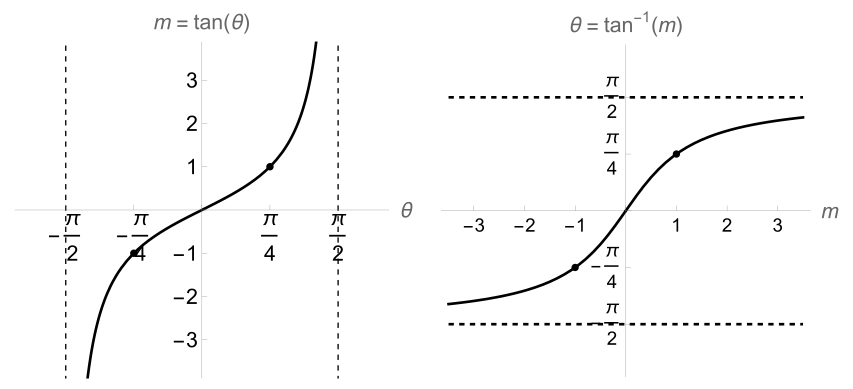
\(\theta = \arctan(m)\text{,}\) we reflect the graph of
\(m = \tan(\theta)\) across the line
\(m = \theta\) and interchange coordinates on their respective graphs.
Looking at the left graph, we observe
-
The domain of arctangent is
\((-\infty,\infty)\) and the range is
\((-\pi/2,\pi/2)\text{.}\)
-
The vertical asymptotes of tangent now become horizontal asymptotes of arctangent at
\(\theta = \pm \pi/2\text{.}\)