Logo image

Precalculus JumpStart

Section 8.1 Exponential Functions

An exponential function takes its real number input as the exponent in a power. For example, \(f(x) = 2^x\) is the base \(2\) exponential function. In this case, the base \(2\) is held constant, while the exponent \(x\) varies. Contrast this with a power function such as \(g(x) = x^2\text{,}\) which is not an exponential function. We can form an exponential function using any reasonable real number \(b\) for a base.

Definition 8.1.1.

Suppose \(b \gt 0\) and \(b\neq 1\text{.}\) The base \(b\) exponential function is defined by
\begin{equation*} f(x) = b^x, \end{equation*}
for all real numbers \(x\text{.}\)

Example 8.1.2. The Doubling Function.

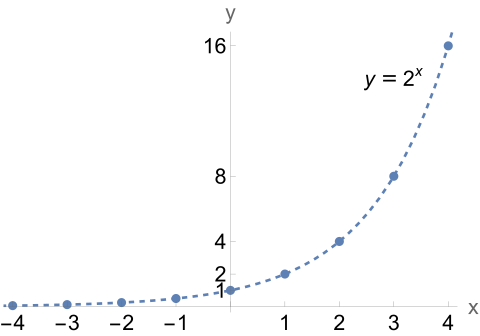
The base \(2\) exponential function is \(f(x) = 2^x\text{.}\) Let’s evaluate it at some positive integer values.
\(x\) \(y = 2^x\)
\(1\) \(2^1 = 2\)
\(2\) \(2^2 = 4\)
\(3\) \(2^3 = 8\)
\(4\) \(2^4 = 16\)
Each time we increase the input \(x\) by one, we double the output \(y\text{.}\) So you might call this the β€œdoubling function”.
What about at some negative integers? This would be a good place to review SectionΒ 3.3!
\(x\) \(y = 2^x\)
\(-1\) \(2^{-1} = \frac{1}{2}\)
\(-2\) \(2^{-2} = \frac{1}{4}\)
\(-3\) \(2^{-3} = \frac{1}{8}\)
\(-4\) \(2^{-4} = \frac{1}{16}\)
So as we decrease the input by one, the output is halved. This is consistent with the doubling observed above. Plotting these points and filling in the gaps we obtain its graph.
Observe the following features of the graph:
  1. The domain of \(f(x) = 2^x\) is \((-\infty,\infty)\) while the range is \((0,\infty)\text{.}\)
  2. The \(y\)-intercept is at \((0,1)\) because \(f(0) = 2^0 = 1\text{.}\)
  3. The graph increases in value from left to right. We refer to this as exponential growth.
  4. The graph decreases in value towards zero from right to left. As such, the we say the graph has a horizontal asymptote at \(y=0\) (the \(x\)-axis) highlighting how the values of \(2^x\) approach zero as \(x\) because large and negative.

Activity 8.1.1. Varying the Base of an Exponential Function.

The magnitude of the base influences the rate at which the graph of \(y=b^x\) β€œgrows” or β€œdecays”. The graph of \(y=b^x\) is plotted below. Move the slider below to control the base \(b\text{.}\)
Figure 8.1.3. Graph of \(y=b^x\text{.}\)

(b)

How would you describe the graph when \(0 \lt b \lt 1\text{?}\)

(d)

How does the base \(b\) affect the domain and range of the exponential function?

(e)

How does the base \(b\) affect the \(y\)-intercept of the exponential function?

(f)

Summarize: for which bases \(b\) is the function growing exponentially (increasing)? For which bases is the function decaying exponentially (decreasing)?

Example 8.1.4. Identifying Exponential Functions.

Show that the function below is exponential by using laws of exponents to rewrite in the form \(y = b^x\) to determine its base. Sketch a graph of the function.
  1. \(\displaystyle \displaystyle f(x) = 2^{-x}\)
  2. \(\displaystyle \displaystyle g(x) = 2^{3x}\)
Solution.
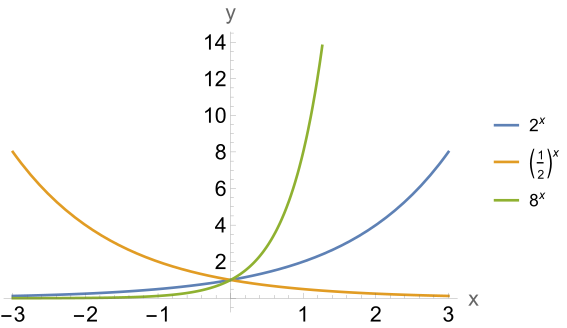
  1. \(\displaystyle f(x) = 2^{-x} = \frac{1}{2^x} = \left(\frac{1}{2}\right)^x\) is the base \(1/2\) exponential function. This function decays exponentially and its graph is that of \(y=2^x\) reflected over the \(y\)-axis.
  2. \(\displaystyle g(x) = 2^{3x} = (2^3)^x = 8^x\) is the base \(8\) exponential. This function grows exponentially significantly faster than \(y = 2^x\text{.}\)
Both functions share the same \(y\)-intercept at \((0,1)\text{,}\) have domain \((-\infty,\infty)\text{,}\) range \((0,\infty)\text{,}\) and a horizontal asymptote of \(y=0\text{.}\)

Example 8.1.5. Transforming Exponential Functions.

Sketch the graph of each of the following exponential curves. A video solution follows.
  1. \(y = 2^x - 3\text{.}\)
  2. \(y = 2^{x - 3}\text{.}\)
  3. \(y = 3\cdot 2^{x}\text{.}\)
Solution.

Example 8.1.6. Exponential Models.

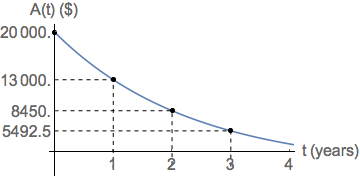
The value in dollars of a car after \(t\) years since purchase depreciates according to the formula
\begin{equation*} A(t) = 20000\times (0.65)^t. \end{equation*}
  1. Find the original value of the car before depreciation.
  2. Find the value of the car after one year. By what percentage has the car depreciated?
  3. By what percentage has the car depreciated after two years?
  4. By what percentage has the car depreciated after three years?
Solution.
Evaluating at \(t = 0\) gives
\begin{equation*} A(0) = 20000 \times (0.65)^0 = 20000 \end{equation*}
so that the initial purchase price is 20,000 dollars. After \(t = 1\) year,
\begin{equation*} A(1) = 20000 \times (0.65) = 13000 \end{equation*}
which is 65 percent of the original price; the car has lost 35 percent of its value. After two years,
\begin{equation*} A(2) = 20000 \times (0.65)^2 = 8450 \end{equation*}
so that the car has depreciated by
\begin{equation*} \frac{\text{(change in price)}}{\text{(purchase price)}} = \frac{20000-8450}{20000} = \frac{11550}{20000} = 57.75\%. \end{equation*}
After three years,
\begin{equation*} A(3) = 20000\times (0.65)^3 = 5492.50 \end{equation*}
so that the value has depreciated
\begin{equation*} \frac{20000-5492.50}{20000} = \frac{14507.50}{20000} \approx 72.54\% \end{equation*}
The function \(A\) is an example of a base \(0.65\) exponential function scaled so that its \(y\)-intercept coincides with the purchase price.
Figure 8.1.7. Car depreciation as a function of time