Example 7.8.1.
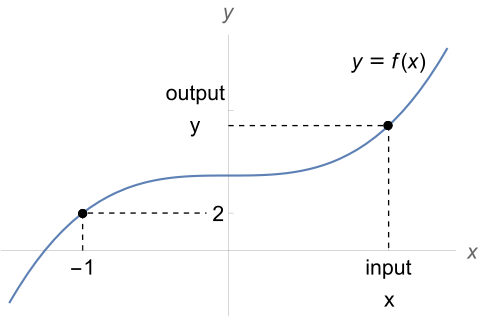
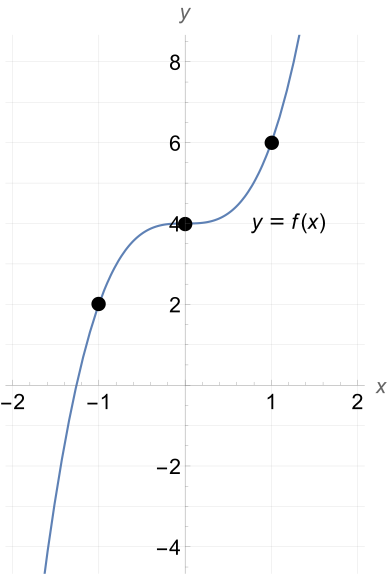
Let \(f(x) = 2 x^3 +4\text{.}\) Consider the following two contrasting problems.
-
Evaluate \(f\) at \(x=-1\text{.}\)
-
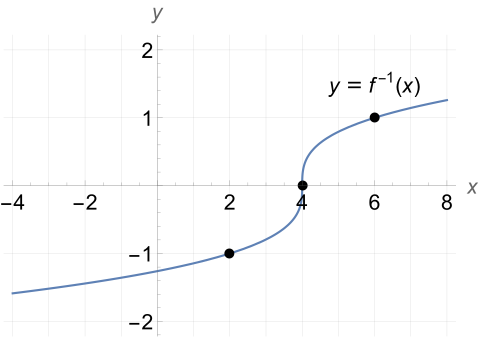
The inverse problem: Find \(x\text{,}\) if \(f(x) = 2\text{.}\)
For the first, we simply evaluate \(f\)
\begin{equation*}
f(-1) = 2(-1)^3 + 4 = -2+4 = 2.
\end{equation*}
For the inverse problem we need to solve the equation \(f(x) = 2\) for \(x\text{.}\)
\begin{align*}
f(x) &= 2\\
2x^3 + 4 &= 2\\
2x^3 &= -2\\
x^3 &= -1\\
x &= \sqrt[3]{-1} = -1
\end{align*}