Skip to main content
Contents Dark Mode Prev Up Next \(\newcommand{\R}{\mathbb R}
\newcommand{\reference}[1]{\overline{#1}}
\newcommand{\lt}{<}
\newcommand{\gt}{>}
\newcommand{\amp}{&}
\definecolor{fillinmathshade}{gray}{0.9}
\newcommand{\fillinmath}[1]{\mathchoice{\colorbox{fillinmathshade}{$\displaystyle \phantom{\,#1\,}$}}{\colorbox{fillinmathshade}{$\textstyle \phantom{\,#1\,}$}}{\colorbox{fillinmathshade}{$\scriptstyle \phantom{\,#1\,}$}}{\colorbox{fillinmathshade}{$\scriptscriptstyle\phantom{\,#1\,}$}}}
\)
Section 10.6 Graphs
Each trigonometric function may be plotted with the angle
\(\theta\) along the horizontal axis and value of the trigonometric function plottend along the vertical axis. Watch the video below to review the graphs of sine, cosine, and tangent. We’ll summarize after the video.
Fact 10.6.1 . Graphs of Sine, Cosine, Tangent.
The graph of
\(y = \cos(\theta)\) and
\(y = \sin(\theta)\) are plotted below with radian measure of the angle along the horizontal axis.
Each function is periodic with period
\(2\pi\text{,}\) so that
\begin{equation*}
\sin(\theta+2\pi) = \sin(\theta), \quad \cos(\theta+2\pi)= \cos(\theta).
\end{equation*}
The graph of
\(y = \tan(\theta)\) is plotted below with radian measure of the angle along the horizontal axis.
Tangent is periodic with period
\(\pi\text{,}\) so that
\begin{equation*}
\tan(\theta+\pi) = \tan(\theta).
\end{equation*}

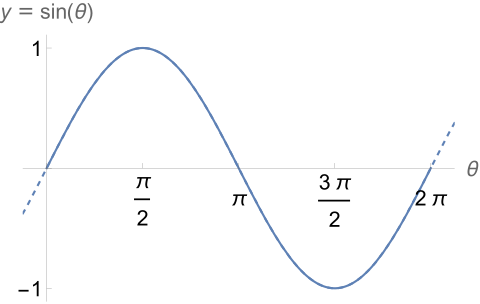
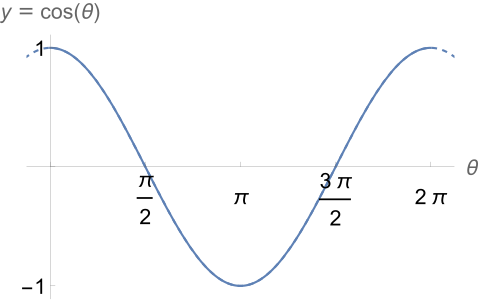 Each function is periodic with period \(2\pi\text{,}\) so that
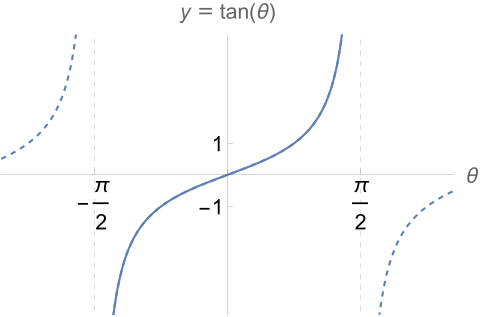 Tangent is periodic with period \(\pi\text{,}\) so that
