Linear equations can provide simple models of real-life scenarios. The essential feature of a linear model is a constant rate of change determined by the slope of the line.
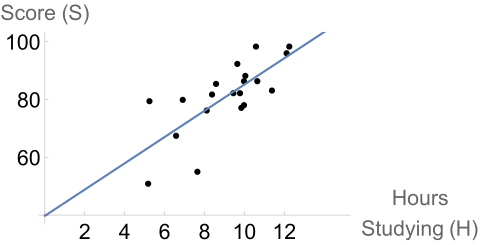
Researchers collected data on the number of hours students studied for an important professional certification exam. They performed a common statistical technique called linear regression to establish a best-fit linear model of the data and found the linear relationship
\begin{equation*}
S = 4.5H + 40,
\end{equation*}
where \(H\) is the number of hours studied and \(S\) is the predicted score on the exam.
For each hour of studying, the model predicts an increased score of \(4.5\) points. This rate of change of \(4.5\)points per hour is seen graphically in the steepness or slope of the graph of the line.
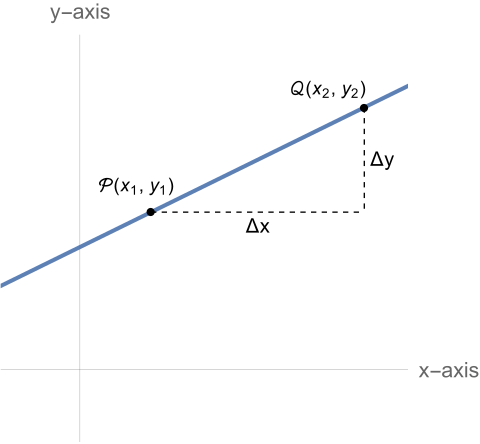
The slope \(m\) of a line in the coordinate plane is the ratio of the change in \(y\) over the change in \(x\) between any two different points on the line.
Precisely, suppose \(\mathcal{P}(x_1,y_1)\) and \(\mathcal{Q}(x_2,y_2)\) are two points on a line with \(x_1 \neq x_2\text{.}\) Then
\begin{equation}
m = \left(\text{slope}\right) = \frac{\text{change in $y$}}{\text{change in $x$}} = \frac{y_2-y_1}{x_2-x_1} = \frac{\Delta y}{\Delta x} = \frac{\text{rise}}{\text{run}}\tag{6.4.1}
\end{equation}
The symbol \(m\) is commonly used for the slope of a line. The vertical change in \(y\) is often called the rise and is denoted \(\Delta y\text{,}\) where the Greek letter "delta" is used to indicate change (difference). Similarly, horizontal change in \(x\) is often called the run and is denoted \(\Delta x\text{.}\)
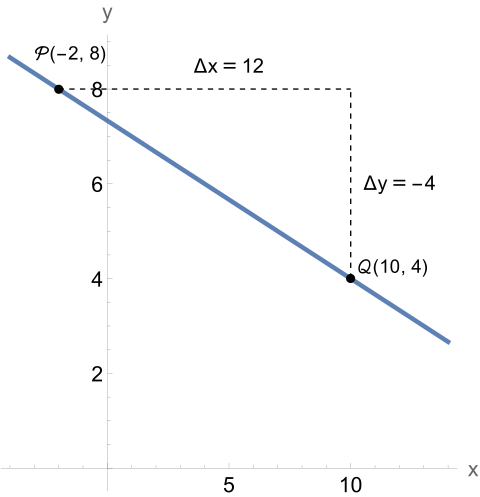
The slope is negative, indicating that an increase of \(3\) unitsin the \(x\)-coordinate will result in a decrease of \(1\) unitin the \(y\)-coordinate.
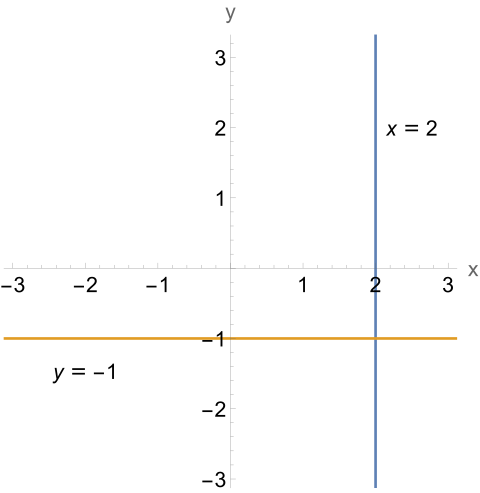
The graph of a linear equation of the form \(y=k\) is a horizontal line and its slope is zero. This is because a change in \(x\) results in no change in \(y\text{.}\) On the other hand, a linear equation of the form \(x=h\) is a vertical line and its slope is undefined. This is because the change in the \(x\)-coordinates between any two points on the line is zero and we must never divide by zero.

 For each hour of studying, the model predicts an increased score of \(4.5\) points. This rate of change of \(4.5\) points per hour is seen graphically in the steepness or slope of the graph of the line.