Skip to main content
Contents Dark Mode Prev Up Next \(\newcommand{\R}{\mathbb R}
\newcommand{\reference}[1]{\overline{#1}}
\newcommand{\lt}{<}
\newcommand{\gt}{>}
\newcommand{\amp}{&}
\definecolor{fillinmathshade}{gray}{0.9}
\newcommand{\fillinmath}[1]{\mathchoice{\colorbox{fillinmathshade}{$\displaystyle \phantom{\,#1\,}$}}{\colorbox{fillinmathshade}{$\textstyle \phantom{\,#1\,}$}}{\colorbox{fillinmathshade}{$\scriptstyle \phantom{\,#1\,}$}}{\colorbox{fillinmathshade}{$\scriptscriptstyle\phantom{\,#1\,}$}}}
\)
Section 8.3 Logarithmic Functions
Exponential functions are one-to-one and therefore have inverse functions, called
logarithms . (See
Section 7.9 to review inverse functions.)
Definition 8.3.1 . Logarithmic Functions.
Suppose \(a \gt 0\) and \(a \neq 1\text{.}\) The base \(a\) exponential function \(f(x) = a^x\) has an inverse function called the base \(a\) logarithmic function denoted
\begin{equation*}
f^{-1}(y) = \log_a (y), \quad y \gt 0.
\end{equation*}
The domain of the logarithm is the range \((0,\infty)\) of the exponential function. As inverse functions, they satisfy \((f^{-1}\circ f )(x) = x\) and \((f\circ f^{-1})(y) = y\) which now becomes
\(\displaystyle \log_a(a^x) = x\) for all \(x\)
\(\displaystyle a^{\log_a(y)} = y\) for all \(y \gt 0\)
Alternatively, exponential equations are equivalent logarithmic equations according to the relationship
\begin{equation}
y = a^x \quad \text{if and only if} \quad \log_a(y) =x.\tag{8.3.1}
\end{equation}
Observe that the logarithm returns the exponent in the exponential equation.
Example 8.3.2 . The Base \(2\) Logarithm.
This video discusses the case of the base 2 logarithm.
Example 8.3.3 . Evaluating Logarithmic Expressions.
Evaluate the following expressions without the use of calculator. Video solutions follow.
\(\displaystyle \log_2(8)\)
\(\displaystyle \log_8(2)\)
\(\displaystyle \log_{\pi}\left(\frac{1}{\pi^8}\right)\)
\(\displaystyle \log_{\pi} (1)\)
\(\displaystyle \pi^{\log_{\pi}(2)}\)
Example 8.3.4 . Evaluating Logarithms.
Evaluate the following logarithms without the use of calculator.
\(\displaystyle \displaystyle \log_{5} (25)\)
\(\displaystyle \displaystyle \log_{5} \left(\frac{1}{5}\right)\)
\(\displaystyle \displaystyle \log_{\frac{1}{5}} \left(5\right)\)
\(\displaystyle \displaystyle \log_{5} \left(\sqrt{5}\right)\)
\(\displaystyle \displaystyle \log_{5} \left(5\right)\)
\(\displaystyle \displaystyle \log_{5} \left(1\right)\)
\(\displaystyle \displaystyle \log_{5} \left(-1\right)\)
Solution .
\(\displaystyle 5^\boxed{2} = 25 \quad\Rightarrow\quad \log_{5} (25) = \boxed{2}\)
\(\displaystyle 5^{\boxed{-1}} = \frac{1}{5} \quad\Rightarrow\quad \log_{5} \left(\frac{1}{5}\right) = \boxed{-1}\)
\(\displaystyle \left(\frac{1}{5}\right)^{\boxed{-1}} = 5 \quad\Rightarrow\quad \log_{\frac{1}{5}} \left(5\right) = \boxed{-1}\)
\(\displaystyle 5^{\boxed{1/2}} = \sqrt{5} \quad\Rightarrow\quad \log_{5} \left(\sqrt{5}\right) = \boxed{1/2}\)
\(\displaystyle 5^{\boxed{1}} = 5 \quad\Rightarrow\quad \log_{5} \left(5\right) = \boxed{1}\)
\(\displaystyle 5^{\boxed{0}} = 1 \quad\Rightarrow\quad \log_{5} \left(1\right) = \boxed{0}\)
\(5^x \gt 0\text{,}\) for all \(x\text{.}\) In particular, \(5^x \neq -1\) for any \(x\text{.}\) Thus \(\log_{5} \left(-1\right)\) is undefined.
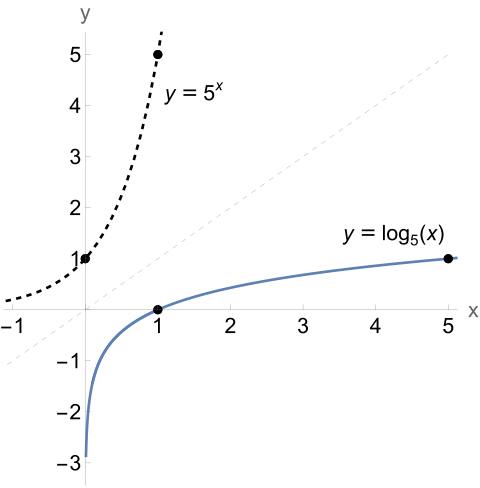
Example 8.3.5 . Graphing a Logarithmic Function.
To sketch the graph of
\(y = \log_5 (x)\) begin by sketching the graph of its inverse function
\(y = 5^x\) (dashed curve). Then reflect the graph across
\(y=x\) interchanging coordinates of points as you do. The horizontal asymptote of
\(y = 5^x\) will become the vertical asymptote of
\(y = \log_5 (x)\) (solid curve).
Observe how the rapid exponential growth of
\(y = 5^x\) becomes the slow
logarithmic growth of
\(y = \log_5 (x)\text{.}\)