A linear function changes at a constant rate of change determined by its slope. For example, the value of function \(f(x) = -2.3x +7\)decreases\(2.3\) units per unit increase in \(x\text{.}\) Non-linear functions have a non-constant rate of change, but it is still useful to attempt to study the way they change. In fact, a good portion of calculus addresses this particular question.
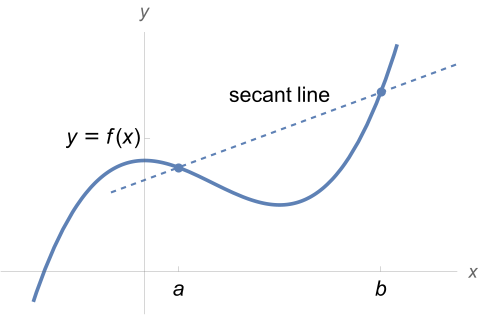
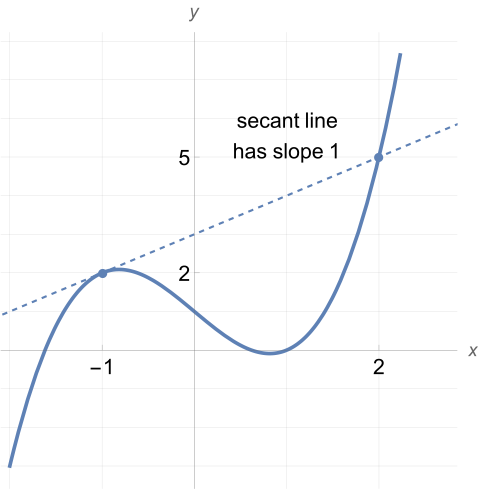
The best we can do right now is measure the average rate of change of a function over some interval. To do this, we measure the slope of a line joining two points on the graph called a secant line. In the graph below, I’ve sketched the secant line joining between \(x=a\) and \(x=b\) on the graph of \(y=f(x)\text{.}\)
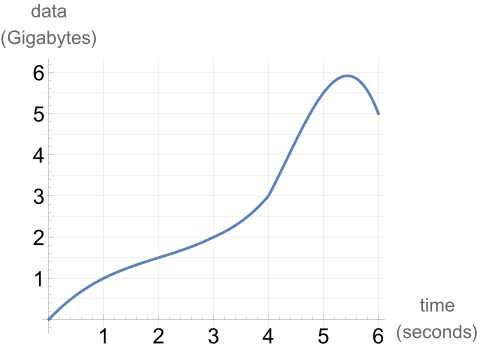
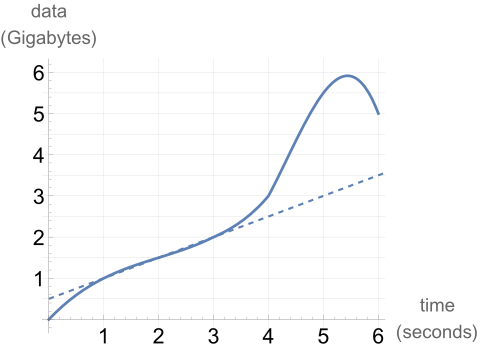
The graph below shows the amount of data transferred (in gigabytes) over a secure network during a \(6\) second period of time.
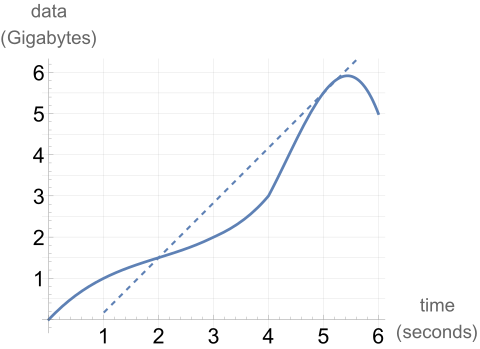
Find the average rate of data transfer during the time interval starting at \(t = 2\) seconds and ending at \(t = 5\) seconds. What units does this have? Draw the corresponding secant line on the graph.
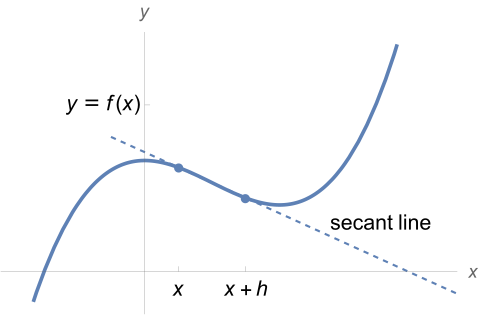
In calculus, we will want to consider the difference quotient over small intervals \([x,x+h]\text{,}\) where \(h\neq 0\) is a small non-zero amount. This puts the two points on the graph close together.
The slope of this secant line does a good job of measuring the rate of change of the function at \(x\text{.}\) In this case, the difference quotient ((7.10.1)) takes the form