Example 10.2.1. Determining the Sign.
Suppose \(\theta\) is a Quadrant III angle. Determine which trigonometric function values of \(\theta\) are positive and which are negative.
Solution.
Points \((x,y)\) in Quadrant III satisfy \(x \lt 0\) and \(y \lt 0\text{.}\) 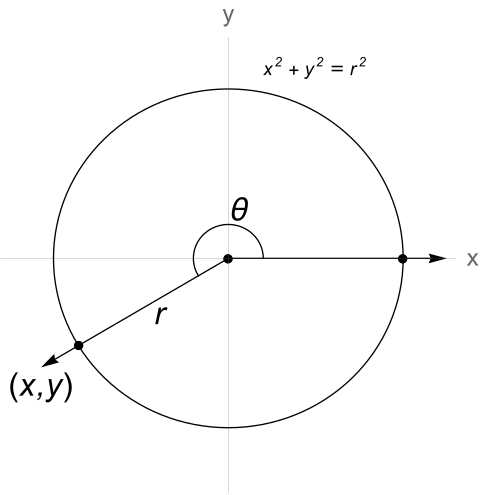 Note that \(r = \sqrt{x^2+y^2} \gt 0\) is always positive. Thus, by Definition 10.1.1
\begin{gather*}
\sin(\theta) = \frac{y}{r} \quad \text{is negative}\\
\cos(\theta) = \frac{x}{r} \quad \text{is negative}\\
\tan(\theta) = \frac{y}{x} \quad \text{is positive}\\
\csc(\theta) = \frac{r}{y} \quad \text{is negative}\\
\sec(\theta) = \frac{r}{x} \quad \text{is negative}\\
\cot(\theta) = \frac{x}{y} \quad \text{is positive}
\end{gather*}
So in Quadrant III only the tangent and its reciprocal are positive.