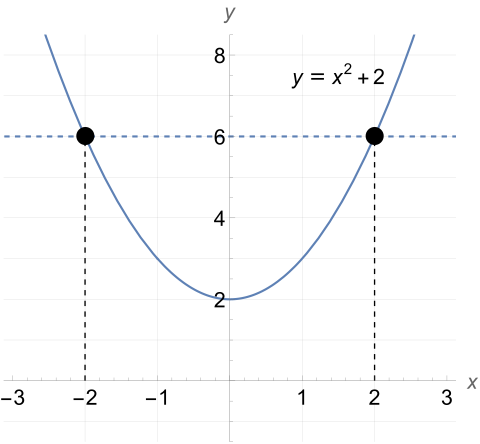
Thus, \(x=2\) or \(x = -2\) and it is impossible to determine which value I evaluated \(f\) at to get \(6\text{.}\) So while we have limited the possibilities to two different possible values, we cannot explicitly determine the input to the function from the output.
The problem here is two distinct inputs \(-2 \neq 2\) result in the same output \(f(-2)=f(2)\text{.}\) Graphically, the horizontal line \(y=6\) intersects the graph at two different points corresponding to the two distinct inputs.
To avoid this situation, we require that each output of a function \(f\) corresponds to exactly one input. Such functions are called one-to-one functions.
A function \(f\) is one-to-one if whenever \(a\neq b\) are in the domain of \(f\text{,}\) then \(f(a)\neq f(b)\text{.}\) That is, distinct inputs to \(f\) result in distinct outputs.
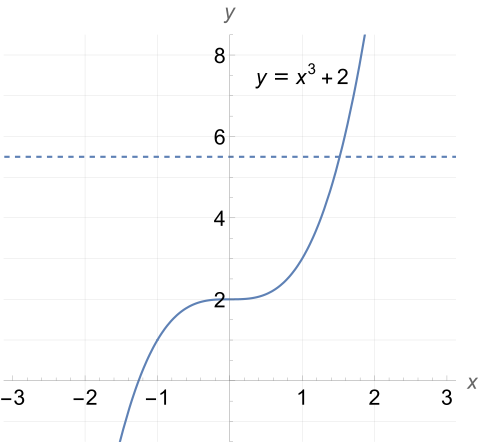
Graphically, if distinct inputs are to give distinct outputs, a horizontal line should never pass through the graph more than once. This is called the horizontal line test.