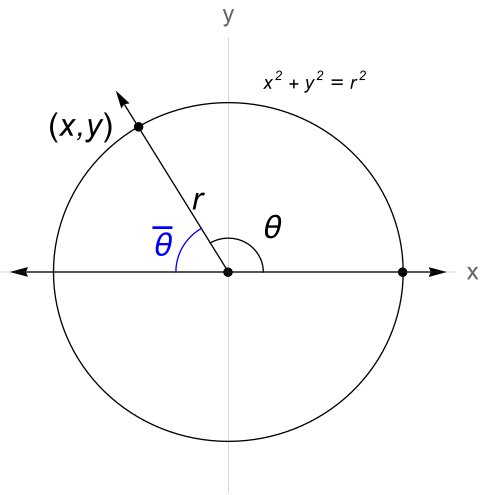
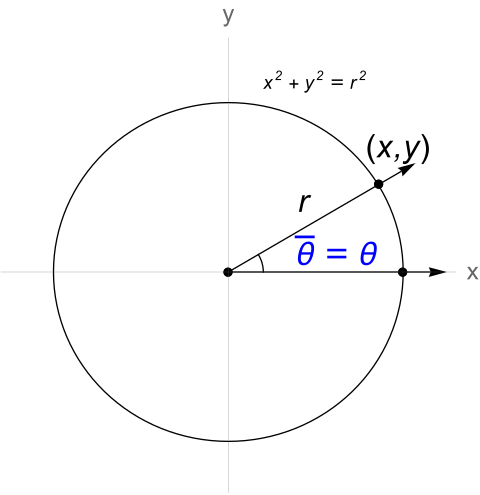
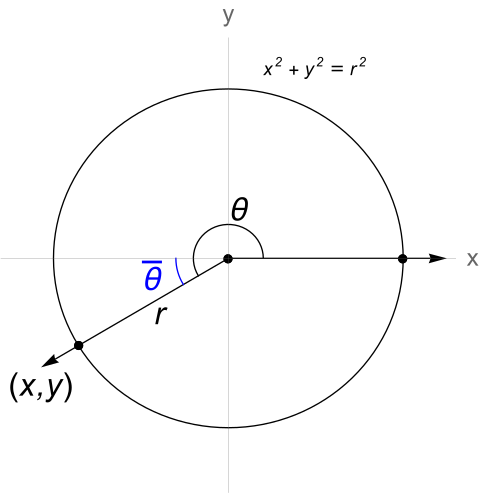
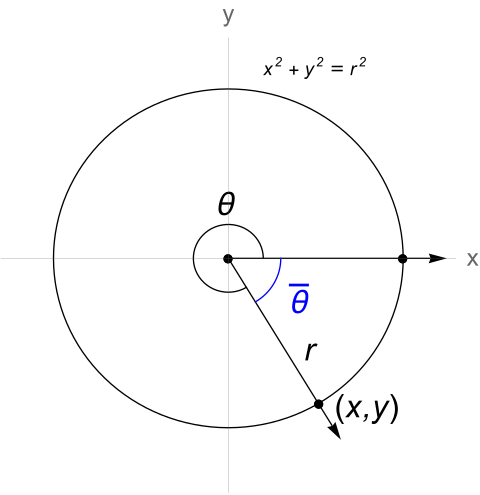
Associated to every non-quadrantal angle is an acute angle called its reference angle. We will see that the reference angle and the quadrant completely determine its trigonometric function values.
Suppose \(\theta\) is a non-quadrantal angle in standard position. The reference angle of \(\theta\text{,}\) denoted by \(\reference{\theta}\text{,}\) is the smallest positive angle formed by the terminal ray of \(\theta\) and the \(x\)-axis.
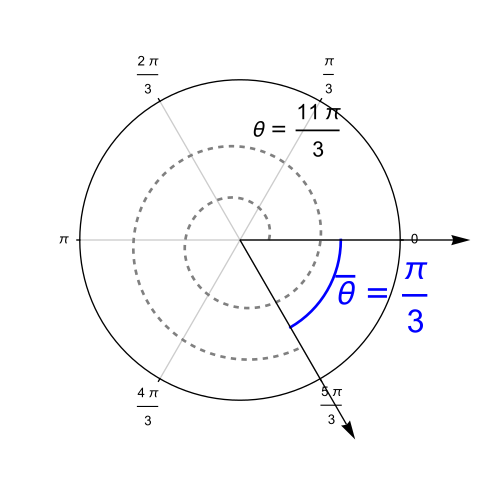
Study the Definition 10.3.1 above and each figure below to see how the reference angle is determine in each quadrant for \(0 \lt \theta \lt 2\pi\text{.}\)
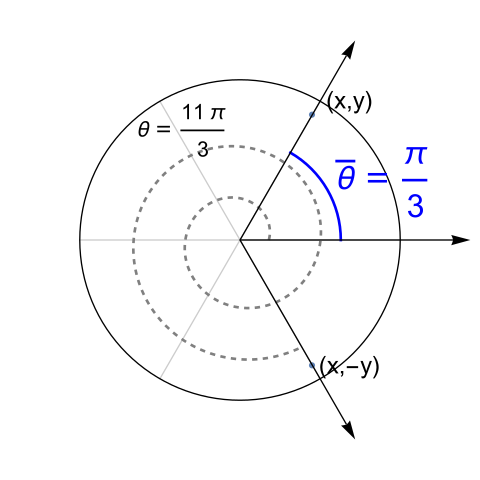
The reference angle is formed by the terminal ray and the positive \(x\)-axis. This smallest such positive angle is \(\reference{\theta} = \pi/3\text{.}\) Drawing and \(\theta\) and \(\reference{\theta}\) both in standard position highlights why its a useful to consider the reference angle.
If \((x,y)\) is a point on the terminal side of \(\reference{\theta}\text{,}\) then after adjusting for the quadrant, \((x,-y)\) is a point on the terminal side of \(\theta\text{.}\) Thus, all the trigonometric function values of \(\theta\) and \(\reference{\theta}\) are the same or opposite and the sign is determined entirely by the quadrant. To illustrate, we know sine is negative in Quadrant IV. So,
Suppose \(\theta\) is a non-quadrantal angle with reference angle \(\reference{\theta}\text{.}\) Then the trigonometric function values of \(\theta\) are the same or the opposite of those for \(\reference{\theta}\) with the sign determined by the quadrant. (See Theorem 10.2.2.)