In Section 9.2 we defined the six trigonometric function values of an acute angle \(0 \lt \alpha \lt 90^\circ\text{.}\) In this section we extend our definition of these functions to any angle \(\theta\text{.}\) Much of this is summarized in the video below.
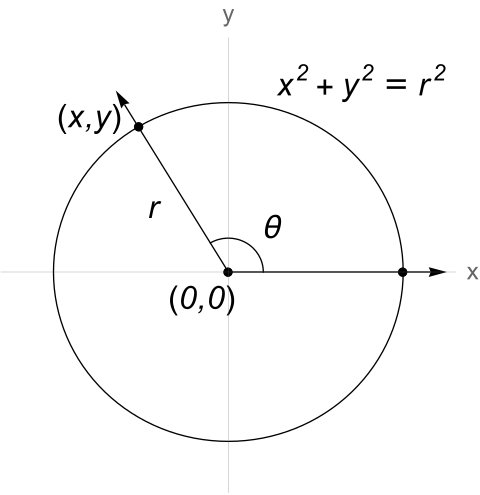
Suppose \(\theta\) is any angle drawn in standard position in the \(xy\)-plane and suppose \((x,y) \neq (0,0)\) is any point on the terminal ray of \(\theta\text{.}\) Let
\begin{equation*}
r = \sqrt{x^2+y^2} \gt 0
\end{equation*}
denote the radial distance form the origin \((0,0)\) to the point \((x,y)\text{.}\) Then \((x,y)\) is a point on the circle \(x^2+y^2=r^2\text{.}\) This setup is summarized in the figure below. Spend some time reviewing it before proceeding.
Example10.1.2.Finding Trigonometric Function Values.
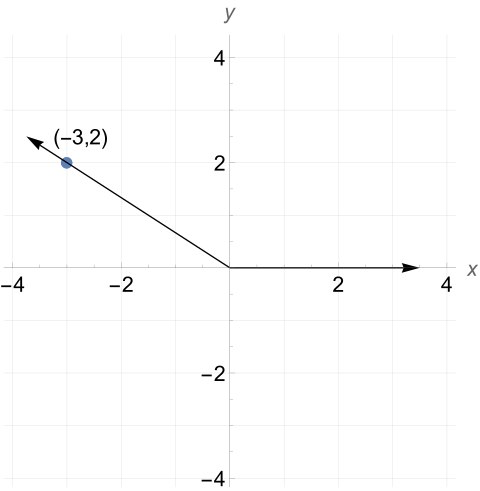
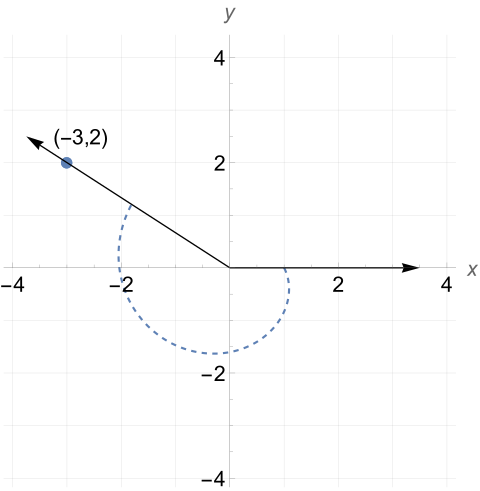
Suppose the terminal side of an angle \(\theta\) in standard position includes the point \((-3,2)\text{.}\) Let’s find the six trigonometric function values of \(\theta\text{.}\)
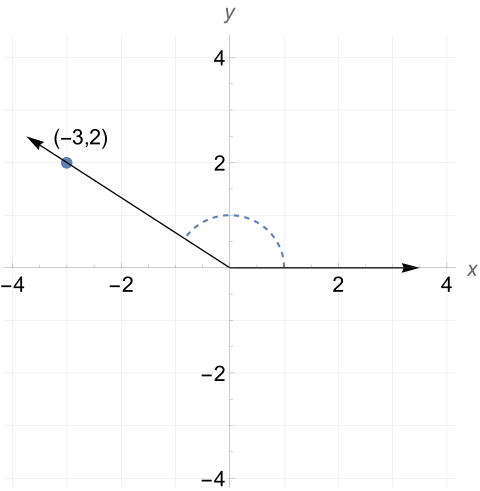
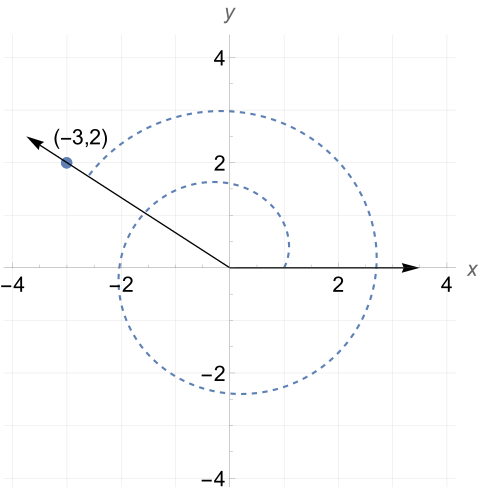
It’s tempting to think we can measure the angle \(\theta\) in the previous example given the point \((-3,2)\text{.}\) But keep in mind there are infinitely many coterminal angles that share that point on its terminal side.
Any of the above angles could be the angle in the example. This does not affect the resulting trigonometric function values: coterminal angles have the same trigonometric function values.
Principle10.1.3.Trigonometric Function Values of Coterminal Angles.
Suppose \(\alpha\) and \(\beta\) are coterminal angles. Then, all trigonometric function values of \(\alpha\) and \(\beta\) are equal, when they are defined.
Example10.1.4.Finding Trigonometric Function Values.
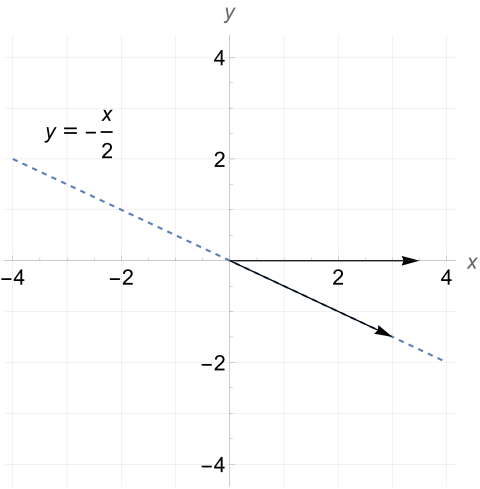
The terminal ray of a Quadrant IV angle \(\theta\) in standard position is parallel to the line \(y = -x/2\text{.}\) Find the sine, cosine, and tangent of \(\theta\text{.}\)
Draw a picture of the line \(y=-x/2\) and the terminal ray in the correct quadrant.
Pick any point on the terminal ray. For instance, if I take \(x=2\text{,}\) then \(y=-2/2 = -1\) so that \((2,-1)\) is a Quadrant IV point on the terminal ray. Then
\begin{equation*}
r = \sqrt{2^2+(-1)^2} = \sqrt{4+1} = \sqrt{5}.
\end{equation*}
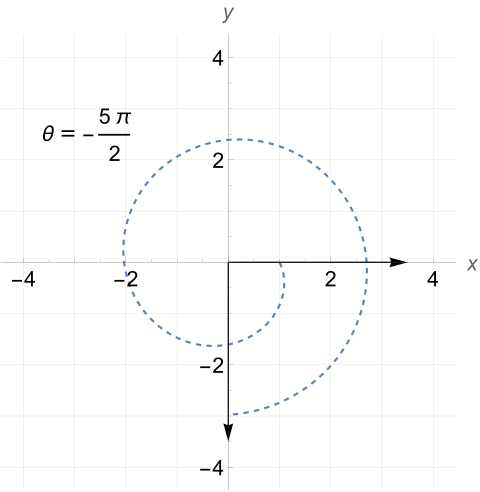
We are given the angle measure and can plot this directly. Recall that \(\pi/2\) is one quarter of a revolution. We should count \(5\) of these quarters in the clockwise orientation.
Pick any point on the terminal side. For instance \((0,-1)\) will suffice. Then \(r = 1\text{.}\)