Skip to main content
Contents Dark Mode Prev Up Next \(\newcommand{\R}{\mathbb R}
\newcommand{\reference}[1]{\overline{#1}}
\newcommand{\lt}{<}
\newcommand{\gt}{>}
\newcommand{\amp}{&}
\definecolor{fillinmathshade}{gray}{0.9}
\newcommand{\fillinmath}[1]{\mathchoice{\colorbox{fillinmathshade}{$\displaystyle \phantom{\,#1\,}$}}{\colorbox{fillinmathshade}{$\textstyle \phantom{\,#1\,}$}}{\colorbox{fillinmathshade}{$\scriptstyle \phantom{\,#1\,}$}}{\colorbox{fillinmathshade}{$\scriptscriptstyle\phantom{\,#1\,}$}}}
\)
Section 11.3 Trigonometric Identities
Trigonometric functions satisfy important equations that inform us about their properties and the relationships between them. An equation involving trigonometric functions which is true for all values of the variables in the domain of the expressions involved is called a
trigonometric identity . In this section, we review the most important identities you should be familiar with. Many of these we have seen before in
Section 10.4 .
Subsection 11.3.1 Basic Identities
The first identities we encounter are the reciprocal and ratio identities that follow from the definitions of the six trigonometric function (see
Definition 10.1.1 ).
Table 11.3.1. Reciprocal and Ratio Identities
Reciprocal Identities
\begin{equation*}
\csc \theta = \frac{1}{\sin \theta}
\end{equation*}
\begin{equation*}
\sec \theta = \frac{1}{\cos \theta}
\end{equation*}
\begin{equation*}
\cot \theta = \frac{1}{\tan \theta}
\end{equation*}
Ratio Identities
\begin{equation*}
\tan \theta = \frac{\sin \theta}{\cos \theta}
\end{equation*}
\begin{equation*}
\cot \theta = \frac{\cos \theta}{\sin \theta}
\end{equation*}
These identities are useful for simplifying expressions involving products and ratios of trigonometric functions.
Example 11.3.2 . Simplifying Trigonometric Expressions.
Simplify the expression by completely reducing and writing your final result without fractions.
\begin{equation*}
\frac{\cos ^6(x) \sec ^2(x)}{\cot ^2(x) \sec ^3(x)}
\end{equation*}
Solution .
\begin{align*}
\frac{\cos ^6(x) \sec ^2(x)}{\cot ^2(x) \sec ^3(x)}
\amp =\cos ^6(x) \sec ^2(x) \tan ^2(x) \cos ^3(x)\\
\amp =\cos ^9(x) \sec ^2(x) \tan ^2(x)\\
\amp =\cos ^9(x) \frac{1}{\cos^2(x)} \tan ^2(x)\\
\amp =\cos ^7(x) \tan ^2(x)\\
\amp =\cos ^7(x) \frac{\sin ^2(x)}{\cos^2(x)}\\
\amp =\cos ^5(x) \sin ^2(x)
\end{align*}
Subsection 11.3.2 Opposite Angle Identities
These identities compare the value of a trigonometric function at an angle
\(\theta\) with its value at the
opposite angle
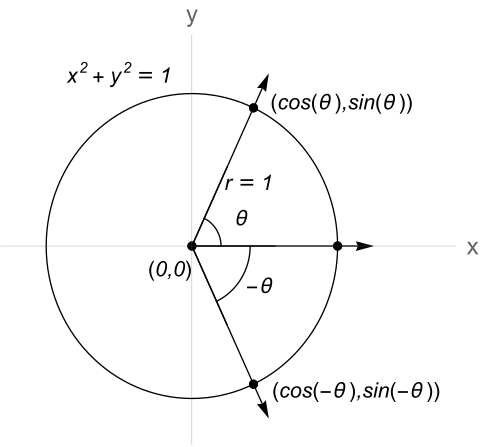
\(-\theta\text{.}\) In the case of sine and cosine, we can see the identity by comparing the corresponding points of these angles on the unit circle. Take a moment to study the figure below.
Observe that the
\(x\) -coordinate of the two points are the same, so that
\(\cos(-\theta) = \cos(\theta)\text{.}\) On the other hand, the
\(y\) -coordinates are opposite, so that
\(\sin(-\theta) = - \sin(\theta)\text{.}\) These identities for the six trigonometric functions are summarized below.
Table 11.3.3. Opposite Angle Identities
\begin{equation*}
\cos(-\theta) = \cos(\theta)
\end{equation*}
\begin{equation*}
\sin(-\theta) = - \sin(\theta)
\end{equation*}
\begin{equation*}
\tan(-\theta) = - \tan(\theta)
\end{equation*}
\begin{equation*}
\sec(-\theta) = \sec(\theta)
\end{equation*}
\begin{equation*}
\csc(-\theta) = - \csc(\theta)
\end{equation*}
\begin{equation*}
\cot(-\theta) = - \cot(\theta)
\end{equation*}
Example 11.3.4 . Using Opposite Angle Indentities.
Prove the opposite angle identity for tangent using the those for sine and cosine and the ratio identity.
Solution .
\begin{equation*}
\tan(-\theta) = \frac{\sin(-\theta)}{\cos(-\theta)} = \frac{-\sin(\theta)}{\cos(\theta)} =-\frac{\sin(\theta)}{\cos(\theta)}= - \tan(\theta).
\end{equation*}
Subsection 11.3.3 Pythagorean Identities
Table 11.3.5. Pythagorean Identities
\begin{equation*}
\sin^2 (\theta) + \cos^2 (\theta) = 1
\end{equation*}
\begin{equation*}
\tan^2 (\theta) + 1 = \sec^2(\theta)
\end{equation*}
\begin{equation*}
1 + \cot^2 (\theta) = \csc^2(\theta)
\end{equation*}
An alternative way of interpreting \(\sin^2(\theta) + \cos^2(\theta) = 1\) is by solving for either the square of sine :
\begin{equation*}
\sin^2(x) = 1- \cos^2(x) = (1- \cos(x))(1+\cos(x))
\end{equation*}
or the square of cosine:
\begin{equation*}
\cos^2(x) = 1- \sin^2(x) = (1-\sin(x))(1+\sin(x))
\end{equation*}
both of which then factor as a difference of squares (see
(4.4.2) ).
Example 11.3.6 . Using Pythagorean Identities.
Add the fractions together and simplify
\begin{equation*}
\frac{1}{1-\cos(t)} + \frac{1}{1+\cos(t)}.
\end{equation*}
Solution .
\begin{align*}
\frac{1}{1-\cos(t)} \amp+ \frac{1}{1+\cos(t)}\\
\amp= \frac{1}{1-\cos(t)}\frac{1+\cos(t)}{1+\cos(t)} + \frac{1}{1+\cos(t)}\frac{1-\cos(t)}{1-\cos(t)}\\
\amp= \frac{1+\cos(t)}{(1-\cos(t))(1+\cos(t))} + \frac{1-\cos(t)}{(1+\cos(t))(1-\cos(t))}\\
\amp= \frac{1+\cos(t)+1-\cos(t)}{(1-\cos(t))(1+\cos(t))}\\
\amp= \frac{2}{(1-\cos(t))(1+\cos(t))}\\
\amp= \frac{2}{1-\cos^2(t)}\\
\amp= \frac{2}{\sin^2(t)}\\
\amp= 2\csc^2(t)
\end{align*}