
Logo image

Precalculus JumpStart

Section 10.5 The Unit Circle

The trigonometric functions sine, cosine, and tangent each play a specific role in the geometry of the unit circle. The key concepts in this section are summarized in the video below.
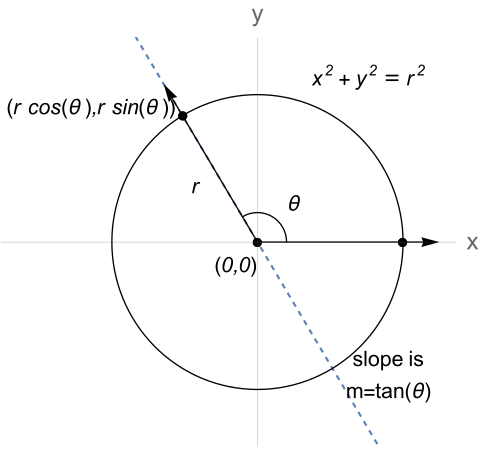
Spend a moment reviewing DefinitionΒ 10.1.1. Each trigonometric function is a certain ratio of \(x\text{,}\) \(y\text{,}\) and \(r\text{,}\) where \((x,y)\) is a point on the circle of radius \(r \gt 0\) centered at the origin \((0,0)\text{.}\) In particular, \(\sin(\theta) = y/r\) and \(\cos(\theta) = x/r\text{.}\) Rewritting these as,
\begin{gather*} y = r\sin(\theta)\\ x = r\cos(\theta) \end{gather*}
we see that the sine and cosine determine the coordinates of points on the circle.
Moreover, \(\tan(\theta) = y/x\) is the slope of the line formed by the terminal side.

Example 10.5.1. Find a Point on a Circle.

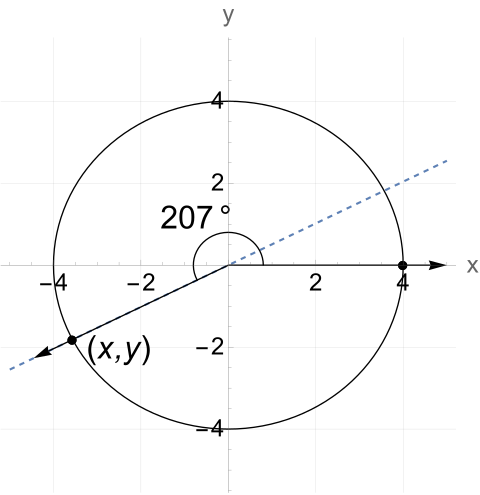
Using a calculator, estimate the coordinates of the point \((x,y)\) on the circle of radius \(4\) determined by the angle \(207^\circ\) in standard position. Then find the slope of the dashed line formed by the terminal side of the angle.
Solution.
\begin{equation*} x = r \cos(207^\circ) \approx 4 times (-0.891) = -3.56 \end{equation*}
\begin{equation*} x = r \sin(207^\circ) \approx 4 times (-0.454) = -1.82 \end{equation*}
\begin{equation*} m = \tan(207^\circ) \approx 0.510 \end{equation*}
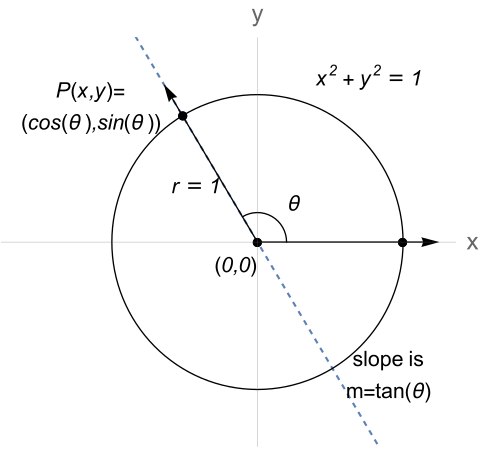
If we restrict to the unit circle with \(r=1\text{,}\) we obtain a very direct interpretation of the three trigonometric functions.

Example 10.5.3. Interpreting Sine, Cosine, and Tangent.

Sketch an angle of 2 (radians) and use a calculator to determine the coordinates of the point it determines on the unit circle.
Solution.
Start with the unit circle. Measure an arc along the circle of 2 units in length--each blue segment is one unit long--to obtain an angle of 2 radians.
Using my calculator in radian mode, we find
\begin{equation*} \cos(2) \approx -0.42 \end{equation*}
\begin{equation*} \sin(2) \approx 0.91 \end{equation*}
\begin{equation*} \tan(2) \approx -2.19 \end{equation*}
So that, the point \((x,y)\) is close to the point \((-0.42,0.91)\) and the slope of the dashed line formed by the terminal side of the angle is about \(-2.19\text{.}\) Take note to confirm that these results have reasonable values and correct signs by estimating in the figure.

