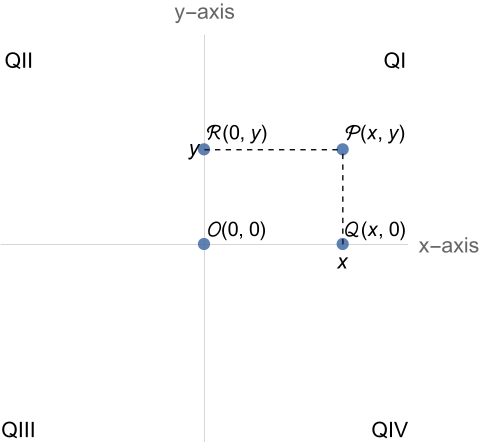
The Cartesian coordinate plane is formed by drawing perpendicular coordinate axes starting at a point called the origin. The location of a point \(\mathcal{P}\) in the plane is determined by an ordered pair of real numbers \((x,y)\) called its coordinates. The first coordinate \(x\) of the pair determines the location of \(\mathcal{P}\) along the horizontal axis and the second coordinate \(y\) of the pair determines its location along the vertical axis.
The origin \(\mathcal{O}\) has coordinates \((0,0)\text{.}\) Points on the \(x\)-axis have coordinates \(\mathcal{Q}(x,0)\text{,}\) with the second coordinate zero. Similarly, points on the \(y\)-axis have coordinates \(\mathcal{R}(0,y)\text{,}\) with the first coordinate zero.
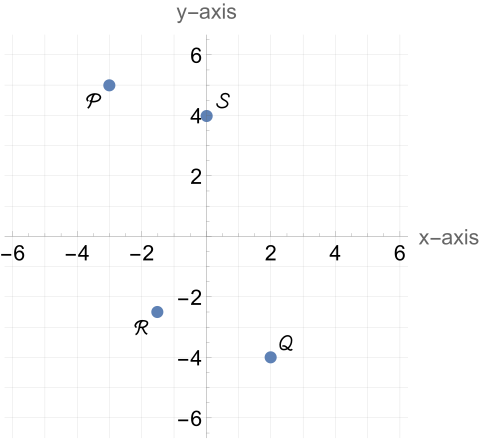
Plot the points \(P(-3,5)\text{,}\)\(\mathcal{Q}(2,-4)\text{,}\)\(\mathcal{R}(-1.5,-2.5)\text{,}\) and \(\mathcal{S}(0,4)\) on the coordinate plane and determine the quadrant of each point, if applicable.
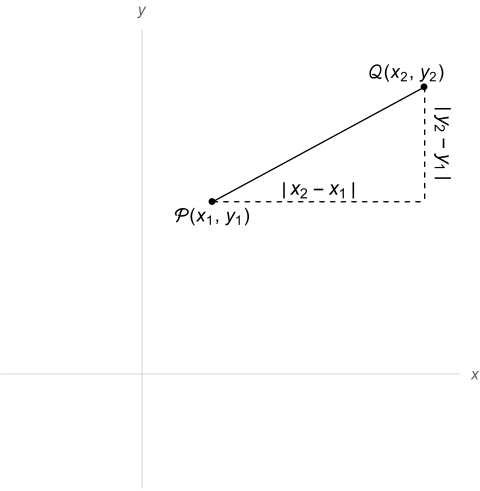
Equation (6.1.1) is a “Pythagorean” expression: sum the squares of the differences of corresponding coordinates and then take the positive square root of this. Note that the order of subtraction is irrelevant due to the squaring: \((a-b)^2 = (b-a)^2\text{.}\)
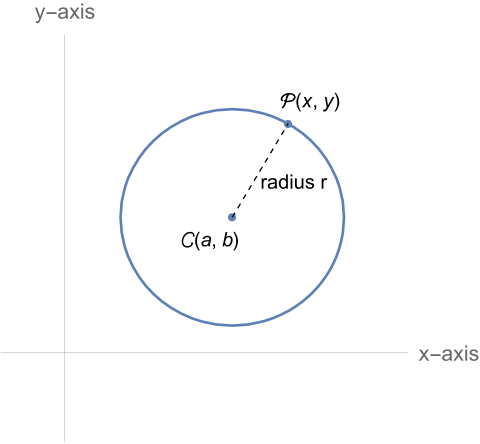
Suppose \(\mathcal{C}(a,b)\) is a point in the plane and \(r\gt 0\) is a positive real number. The circle centered at \(\mathcal{C}\) with radius \(r\) consists of all points \(\mathcal{P}(x,y)\) satisfying
\begin{equation*}
\left(\text{distance between $\mathcal{P}$ and $\mathcal{Q}$}\right) = r
\end{equation*}